Analysis of leaked Stratfor password hashes
After reading an analysis of the leaked Stratfor password hashes elsewhere, I got inspired to do an analysis myself. I was rather surprised by the fact that the report only cracked 81,833 passwords in 4 hours and 53 minutes, so I decided to do a bit of cracking on my own. I did it mainly to see if I could get a more complete view of the passwords used in the Stratfor database.
Over the past years I have gathered a good amount of data and knowledge about how users get around password policies. I'm not going into detail on the Stratfor password policy, as it is already mentioned in the article linked above, but suffice to say, Stratfor, like so many others, has a weak password policy, that makes hashing the passwords almost useless in terms of cracking.
The wordlists#
Some wordlists are freely available, such as the widely known JohnTheRipper wordlist or the one packaged with Cain and Able. The creators of JohnTheRipper even have a public listing of free wordlists, however, the wordlists are designed to give you access to passwords very quickly and thus, they are very small and not very 'complete'. Larger wordlists can be found scattered around the Internet, but they are generally of low quality and most of the time contain garbage that has no resemblance to passwords. There are some better quality wordlists out there, some are free, some are not, but when all is said and done, it is always better to create your own custom wordlists.
Being very eccentric in the field, I have created my own wordlist based on huge amounts of data from the Internet. My personal wordlist is a whopping 14.6 GB and is based on about 5000 smaller wordlists and other data sources. Without duplicates, a password length max of 25 and sorting it according to word frequency makes it very efficient when used in combination with a GPU. I will post more details later on how to create a good wordlist.
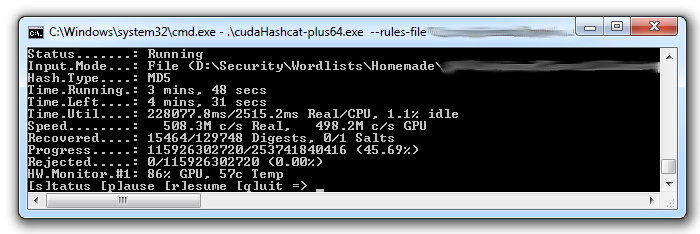
Hashcat-Plus working on a wordlist
Rules#
Some cracking applications can apply rules to passwords, this is also sometimes referred to as word mangling. It is the process of taking a password and applying some sort of transformation to it. I've listed some of the common rules used with "password" as the example:
- Uppercase first char - result: Password
- Append 1 - result: password1
- Duplicate word - result: passwordpassword
- Prepend ! - result: !password
Efficient rules can make your wordlist 10 times more efficient without using more space, at the cost of a little more time. Running all my wordlists with a custom rule-set took about 5 hours.
Brute force#
The effectiveness of brute forcing hashes depends on the password search space, the hashing algorithm and the available hardware. The Stratfor password policy is one of many that has a weak policy, and thus, brute force can be used against the password hashes. Having a good strategy for what set of characters to use is essential to lower the time it takes to brute force hashes. I chose to go all out and crack all hashes from 1-8 characters in length in both uppercase, lowercase and digits. I also did digits up to 12 in length and symbols only up to 10 in length. The total time spent on brute force is 3 days and 14 hours without optimizing hashcat to use the full potential of my graphics card.
The results#
The Stratfor leak contained 860,160 hashes and a total of 746,324 of them were cracked. That is a whopping 86.76% of the hashes!
Length distribution#
- 9.27%≤ 7
- 86.76%8
- 3.98%≥ 9
Characters
Show data
| Characters | Share |
|---|---|
| ≤ 7 | 9.27% |
| 8 | 86.76% |
| ≥ 9 | 3.98% |
Average password length: 7.907926
Character distribution#
Contained in common wordlists#
- In wordlists 10%
- Not in wordlists 90%
Show data
| Category | Share |
|---|---|
| In wordlists | 10% |
| Not in wordlists | 90% |
Top 30 most common passwords#
| Password | Frequency |
|---|---|
stratfor |
12023 |
123456 |
625 |
0 |
519 |
password |
517 |
stratfor1 |
426 |
changeme |
265 |
strat4 |
265 |
1qaz2wsx |
232 |
1234 |
228 |
wright |
179 |
usmcportal |
148 |
abc123 |
89 |
qwerty |
85 |
12345 |
75 |
12345678 |
74 |
Stratfor |
71 |
iloveyou |
56 |
research |
53 |
qqq111 |
53 |
STRATFOR |
50 |
letmein |
47 |
password1 |
46 |
capgroup |
45 |
stratfor09 |
44 |
111111 |
44 |
charlie |
44 |
wgint |
43 |
baseball |
43 |
ranger |
42 |
trustno1 |
42 |
Top 30 longest passwords#
| Password | Length |
|---|---|
QWERTYUIOPASDFGHJKLZXCVBNM |
26 |
1q2w3e4r5t6y7u8i9o0p-[=] |
24 |
bhooshaniyer@gmail.com |
22 |
darrenrose@gmail.com |
20 |
stratfor10stratfor10 |
20 |
vanderleun@gmail.com |
20 |
/,password/,password |
20 |
1234567890qwertyuiop |
20 |
huddersfield@msn.com |
20 |
Hawkeye00@gmail.com |
19 |
Whereiseverybody007 |
19 |
abc1234@hotmail.com |
19 |
1234567891011120000 |
19 |
laurallie@gmail.com |
19 |
jashburn@gmail.com |
18 |
theenemy@gmail.com |
18 |
dontforgetpassword |
18 |
horatio hornblower |
18 |
tsuki777@gmail.com |
18 |
ctannery@gmail.com |
18 |
international1007 |
17 |
heiling@yandex.ru |
17 |
scheidt@gmail.com |
17 |
tisma@hotmail.com |
17 |
lumpenproletariat |
17 |
stratfor1stratfor |
17 |
bandofbrothers007 |
17 |
ghostinthemachine |
17 |
Nachrichtendienst |
17 |
Notes#
It struck me that almost all (86.76%) of the recovered passwords were 8 characters long. A more uniform distribution is normally found in password databases.